Showing posts with label Frances McDormand. Show all posts

Saturday, August 26, 2023

Cars 2/Transformers 3/Audiences 0

It's been a good Summer for Movies. That something you don't see every year. Summers have become the #1 pole position for opening movies—School's Out and kids are getting out—so, the hot months get stuffed with releases for franchises and action movies (the End-of-Year releases are Oscar-bait). But, this year has seen a couple of good, original movies that have beaten the trends—and beaten the franchise box office receipts—and ensured that all the doors of the multiplexes can be opened again.

But, at the time I wrote this—at the time of these films' respective releases—it had been a pretty lousy Summer.

"The Summer of Our Discontent"
or 
"Cash for Clunkers"

You almost don't want to go To the Movies this Summer. Oh, we were warned; so many sequels and comic-book movies, the "experts" pouted and clucked. But the law of averages were in the audience's favor; there had to be something good in "the numbers."* But, this Summer has made me a little gun-shy and I hesitate from pulling the trigger on my credit card for a ticket. Nothing's excited me so far (apart from The Tree of Life**) and it's July already. Of the comics films, only X-Men: First Class had powers and abilities far beyond most super-hero movies—certainly over the previous "X-Men" entries. The 3-D "phenomenon" has constricted budgets, pushed opening dates, and the only thing it seems to add is an extra dimension of "suck" to the productions in the end.

Two recent releases left me so completely unmoved—probably because they were manufactured machine-movies about manufactured machines manufacturing fights with each other—that I thought it best to combine them under one article...so I wouldn't have to spend too much time contemplating their existence, and simply move on. They also evoked the same thought of "What do I care what happens to machines? Machines can be re-built!" 

And movies series can be re-booted. There are a couple I'd like to give the boot to right now.

Ultimately, both films are just long commercials for toys. Better to buy the toys and make your own adventure than what's being served.

"Spare Parts"

I went into the original Cars with exceptionally low expectations, and found a surprisingly fun little film to appeal to the NASCAR crowd and anyone who had a love for the open road. Automobile comedy would seem to be the lowest gear for laughs, but Pixar (and its guru/director John Lasseter, this time co-directing with Brad Lewis) managed a fine film that, if it fell short of the other Pixar products, at least managed to land on all four tires...and that's where the rubber meets the road.

But, what do you do for a victory lap? Go around the field one more time? (Well...yeah). With the novelty of a talking car universe safely a given, Cars 2 expands the concept, so that everything is talking, cars, boats, planes—although the oil-rigs featured are strangely mute.  It also goes global, with an environmental plot about an oil billionaire car (???) who decides to go "green" and develops a new fuel called "Allinol" (heh) and a promotional World Grand Prix to go with it. This gives "Lightning" McQueen (voiced by Owen Wilson) to go head-gasket-to-head-gasket with his racing rival, Francesco Bernoulli (John Turturro, who is having fun) for a best two out of three.
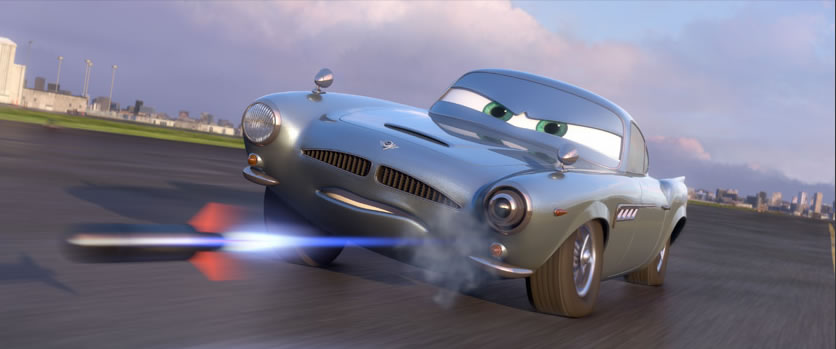
Ah, but there's sand in the gas-tank, when a car-tel of lemon-models (Pacers, Pintos, Gremlins, Ugos) led by an evil genius (my guess it was an Edsel, but I was wrong) wants to exploit a weakness in the gas to destroy the racers in the Grand Prix, and it's up to Special Agent Finn McMissile (voiced by Michael Caine, standing in for a friend, I think)—a gadget-laden Aston Martin/Miata hybrid—and his co-agent Holly Shiftwell (Emily Mortimer) to stop the plot and learn the secret identity of the evil genius behind it all. In a case of mistaken vin numbers, these crack agents think that Mater, the tow-truck (Larry the Cable Guy) is their American contact with information to stop the plot in its tire-tracks.
Now...wait a minute. I know it's a movie about talking cars (fergawdsake), but it takes a new meaning of the term British Intelligence to make that kind of mistake. So, the movie shifts its emphasis from the McQueen caracter to Mater very quickly and the movie never really recovers...I mean, there's only so much Larry the Cable Guy a person can take. The movie's tone has the feel of those '60's films where they used to shoe-horn Rowan and Martin or The Three Stooges into a spy plot because it was "a trend" and they couldn't come up with anything better...or appropriate. 
So, it's all a little "off," the timing chain a little twisted, not sparking on all cylinders. It LOOKS good—the city-scapes haven't looked so lovely since Ratatouille (
although everything looks a little miniaturized, like a play-set), and the movie has a fairly amusing sequence in Japan—but the film moves way too fast to appreciate all the chrome and options and it's too loud and obnoxious that the impulse is to roll the windows up and ignore it. Despite a stellar cast (Vanessa Redgrave voices The Queen?  And did I hear Michael Gambon—uncredited—as the disguised voice of the villain?) and despite its emphasis on Mater, nothing mattersthere's no conflict, there's no drama—just a hokey plot, some slip-shod comedy, and everything running on auto-pilot.
As such, it would have been more appropriate to have Roger Moore as the voice of the spy-car.

Cars 2 may be buffed and shined, but its parts are used and worn, and rather than having that "new car" smell, it has a distinct lemon-scent.
(Wilhelm Alert @ 01: 24)
 ——————————————————————————————————————————

"Rock-Em, Suck'n Robots"

You should have no expectations walking into any film, but you really need to lower your guard going into a Michael Bay construction. His early films are such an annihilation of style over substance—to the point where action sequences are a mashugenah mish-mash between what looks like slo-mo Americana commercials for insurance—that you wonder if the guy at that point had any sort of talent whatsoever (I mean, Tony Scott has the same commercial gloss to his films, but at least you can follow them).

Over time, though, Bay's act has gradually gotten better. The action sequences smoothed out without losing any of the kinetic energy the director was striving for. Maybe there was even a good idea or two among the shrapnel flying through the air. But, the emphasis was always, and will always be I suspect, about demolition derby film-making with the occasional "grace note" of grinning nihilism and exploitive misogyny. One suspects that Michael Bay may become a better film-maker, but he will never grow up.
And he's still playing with toys
. He directed all three "Transformer" movies, including the latest,
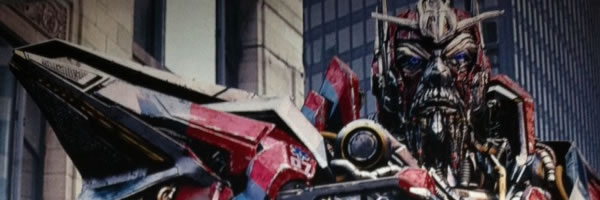
Transformers: Dark of the Moon, and before getting into what's wrong with it, here's what's right: the action sequences, particularly a crazed, high-strung highway chase and a mechanical urban brawl fought on three fronts through the high-rises of Chicago*** are marvels of imagination and quite "followable"—in other words, Bay is starting to understand the logistics of a good action sequence involve perspective and relatable occurrencesthe swooping overhead shots let you see the relationships of what's happening, rather than just presenting a hodge-podge of in-your-face shots.  Yes, they go on too long—the evidence being the kids in the audience who couldn't sit in their seats long enough even when things started to go crash and boom—but at least things made sense, rather than merely noise and rubble.  Now, if he could just have things happen simultaneously—rather than have things stop on the other fronts while he concentrates on one sector—Bay might actually generate something his movies always lack: suspense.
So, the technique is improving, but he's still a far distance from being a mature film-maker.  The few women cast in the film, save
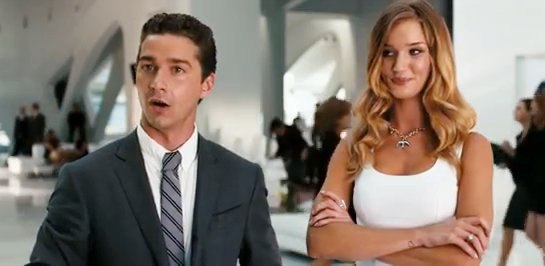
Frances McDormand who manages to retain some inventiveness and dignity in her role, are all dressed like hookers with Bay's camera leering over their curves,
**** the dialogue attempts double entendre but never gets beyond the singular stage, and the annoying Beavis and Butt-head mini-robots from the last film are back and just as juvenile.  The whole movie has the same air of arrested development, although attempts are made to make it seem like it is happening in something more than a fantasy world where aliens disguise themselves as muscle-cars. The plot revolves around a derelict Autobot being salvaged from the Moonits detection being the genesis of Pres. Kennedy's push for a fast lunar landing (and a cameo by "Buzz" Aldrin attempts to lend credibility to the idea).*****  But, there are also "realish-world" cameos by Kennedy (eerily good effects work), Nixon and Robert McNamara (not so much), Walter Cronkite (TV archival footage) and Bill O'Reilly (which negates the credibility factor...a lot). John Turturro returns, and John Malkovich has a small role as a gung-ho business exec. Shia LaBeouf is on-hand (much more caffeinated than usual, probably to be better noticed and for good comic effect, as, Unicron knows, the robots are DEADLY serious), and there's just enough of his parents in this one to outwear their welcome, whereas they were one of the best things in the original. Here, that role is provided by Alan Tudyk, who enlivens the first half of the film before he's made into a functionary.
But, human interaction other than urgently delivered exposition or awkward comedy is rare as human beings become mere flotsam (sometimes literally) in the crushing of gears against gears. Since I've whined in the past that the "Transformers" movies have suffered from "Saved-by-a-White-Man" Syndrome (where a movie's ethnic entities' problems are solved by the usually-white star), this is actually rather refreshing (in fact, the girl-friend/model is the only one who does anything to influence the fight, by displaying the same kvetching characteristic she does with LaBouef's character, a nice touch if you actually believe it inspires what transpires, rather than her merely being turned into designer-charcoal as an annoyance). 

One looks for small signs of hope wherever one can, when one is dealing with something in so need of repair.
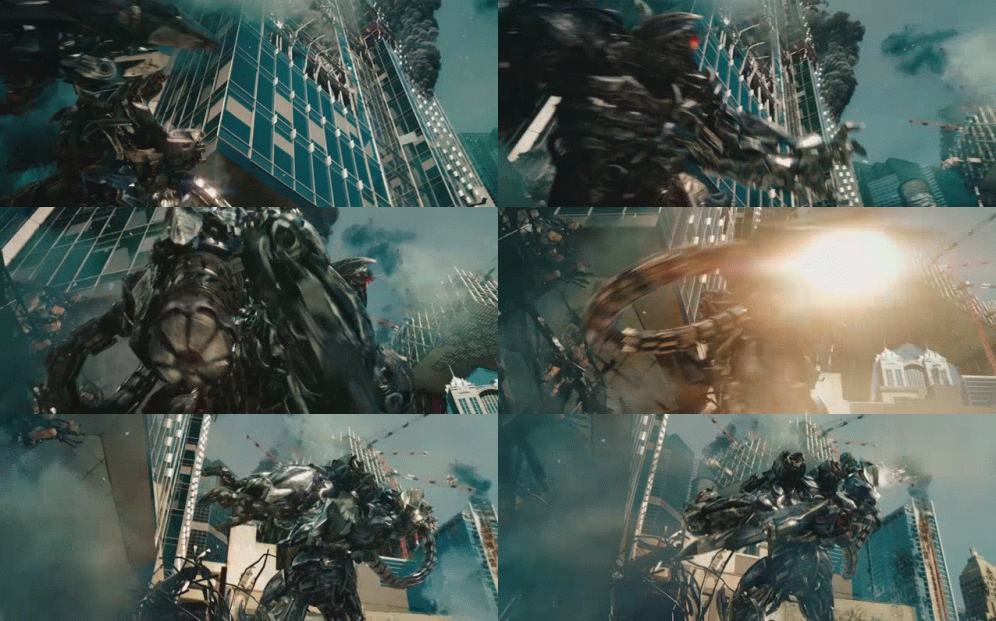
Ultimately, though, for all the metallicrash on the screen, my attention kept returning to my watch...I couldn't wait to get out of there.
One further thought to Bay's detriment: he can't direct 3-D (the format I saw Transformers: DOTM in. On too many occasions, the illusion was spoiled by Bay's insistence in putting an out-of-focus obstructing "something" in between the viewer and the "focus" of the scene...which in 3-D...DOES NOT WORK! The eye wants to focus on the nearest object and move outward in focus, and with merely a "blur" to look at, gets mixed signals, leading to a frustrating viewing experience. Bad idea. And given that Transformers was designed to be shown in 3-D, some bad direction.

* Just because there's a number in the movie title doesn't mean it's going to be bad—it amuses me that the intro on the Cars 2 poster says "From the Makers of Toy Story 3. And there are the inevitable jokes—that Ocean's 11 was followed by Ocean's 12, and I remember a comedian saying about Malcolm X: "I never saw Malcolm I-IX!! I saw Super and Super 8 this Summer...where're the other 6?

** Meek's Cutoff was interesting, but nobody's going to see that.  So much for blazing trails.

*** You shouldn't take these things too seriously or literally, although Roger Ebert in his nicely disingenuous journal entry "On the Origin of Transformers" wonders why such a global conflict should be limited to "the corner of Michigan Avenue and Wacker Drive in Chicago."  Um...budget?

**** Bay's very first shot of the female leadRosie Huntington-Whiteley, a Victoria's Secret Model (but still...) is an up-skirt shot of her walking up a flight of stairs. This isn't exactly the tradition of women making a "grand entrance."

***** This is the same "Buzz" Aldrin who, when confronted by an Apollo landing-hoax enthusiast, hauled off and punched the guy!  Who's getting the black eye now?

Wednesday, May 17, 2023

Moonrise Kingdom

Written at the time of the film's release. A re-viewing of it recently, anticipating his new film, Asteroid City (due June 16th) only reinforced my joy watching it.

A Troubled Young Person's Guide to Themes of Defiant Youth (ala Antonioni) with Kubrickian Stylistics (as interpreted by Wes Anderson)
or
Full Metal Jackasses

Moonrise Kingdom might be my favorite Wes Anderson film yet.* The films of Wes Anderson have gotten more and more juvenile, regressing in sensibility, but progressive in terms of connecting with a child-like world-view. Like his dark companion in film, Tim Burton, Anderson chooses subjects and styles that appeal to his inner kid, pulling in favorite things from his growing up years  to include in his films. But, unlike Burton, he doesn't concentrate on the dark and morose, focusing instead on a sense of wonder, even if in his world-view the adult act like children and the children try to act like adults.
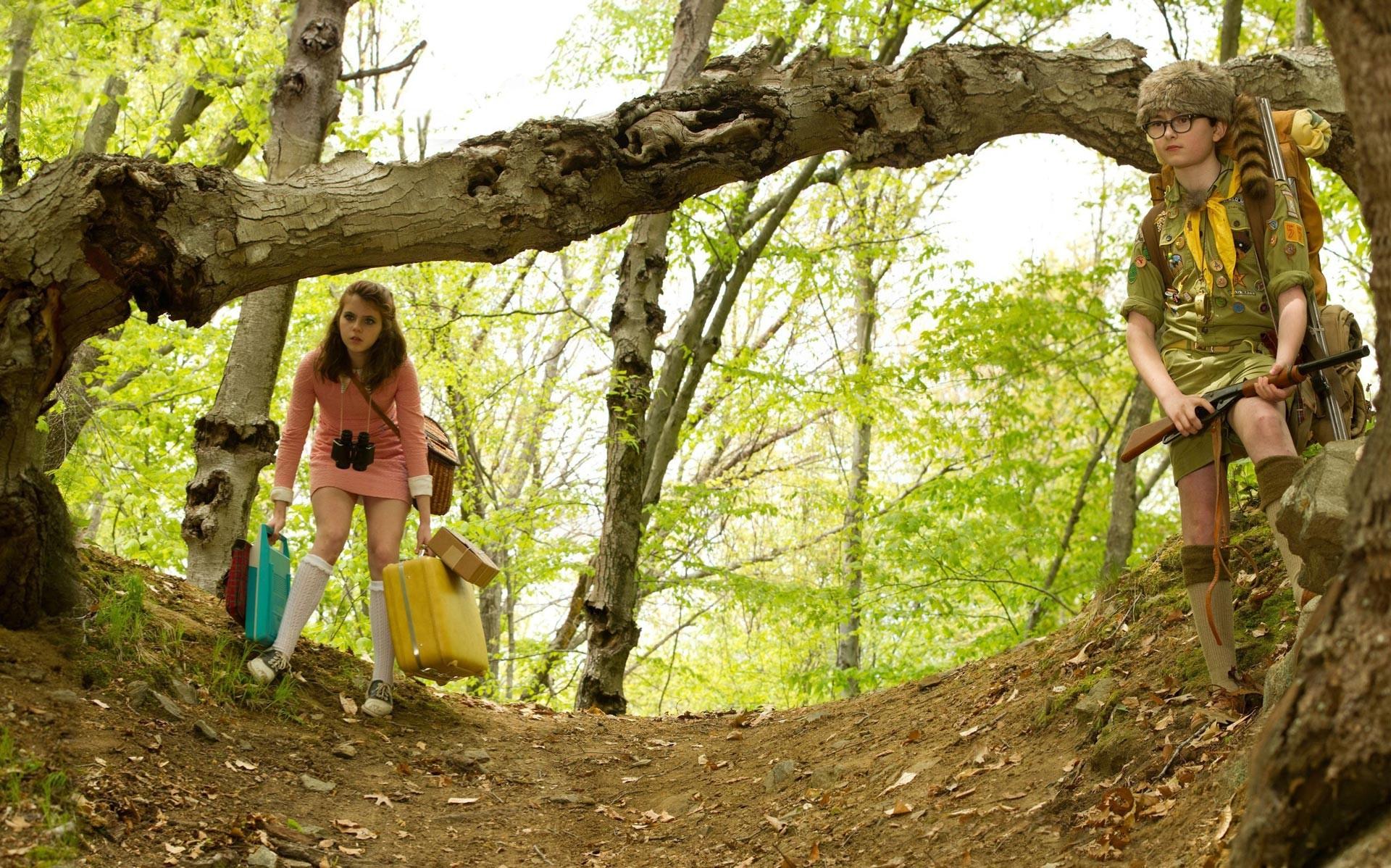
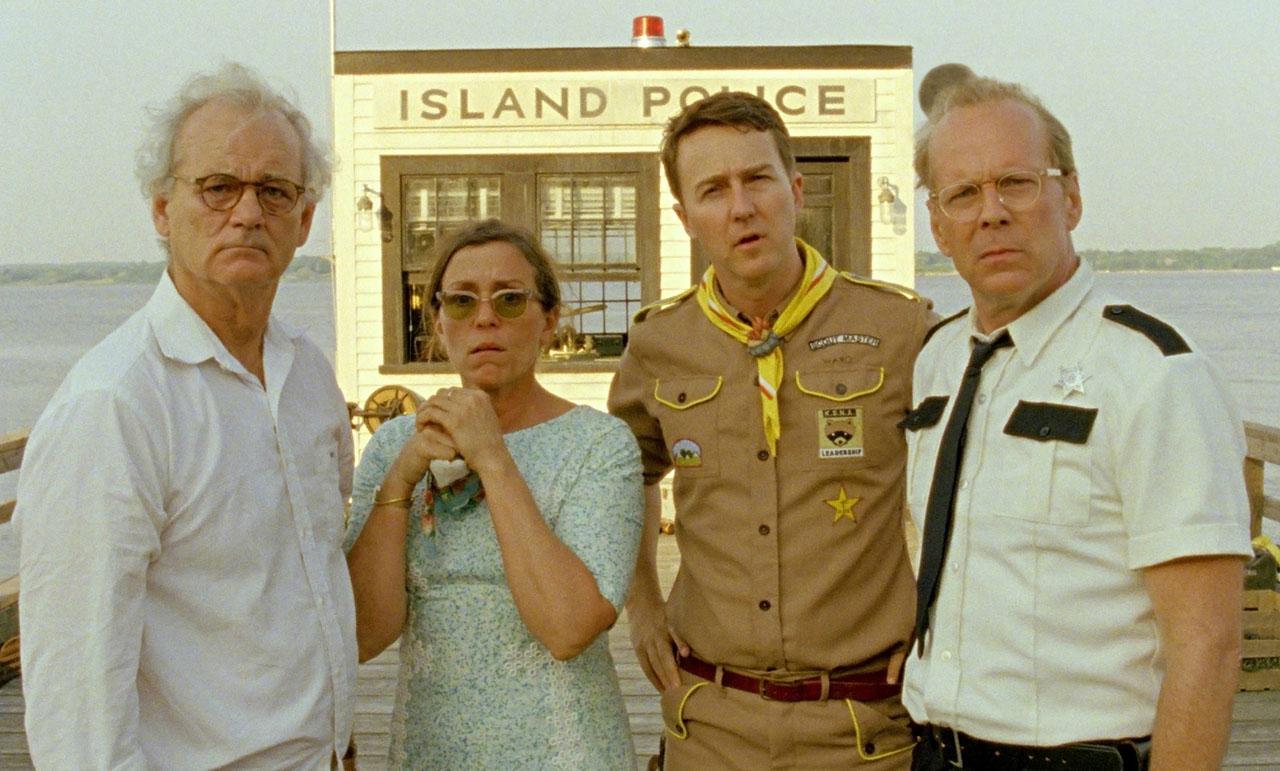
So, Moonrise Kingdom, co-written by Anderson and Roman Coppola (Francis' iconoclastic kid), set in the mid-60's and involving an East coast island community. There are two factions, the authorities, represented by island law enforcement—Captain Sharp (Bruce Willis) and the troop leader of a group of "Khaki Scouts"—Scout Master Ward (Edward Norton). There is a dysfunctional family, the Bishops (led by Bill Murray and Frances McDormand). Both factions represent authority, and empty authority at that. Their worlds are controlled, regimented, but still subject to outside forces and acts of God, like weather—there's a storm approaching as the film's exposition expert (played by Bob Balaban) is only too quick to report.

Into this mix come a pair of star-crossed likers, outcasts from both houses, like Romeo and Juliet.
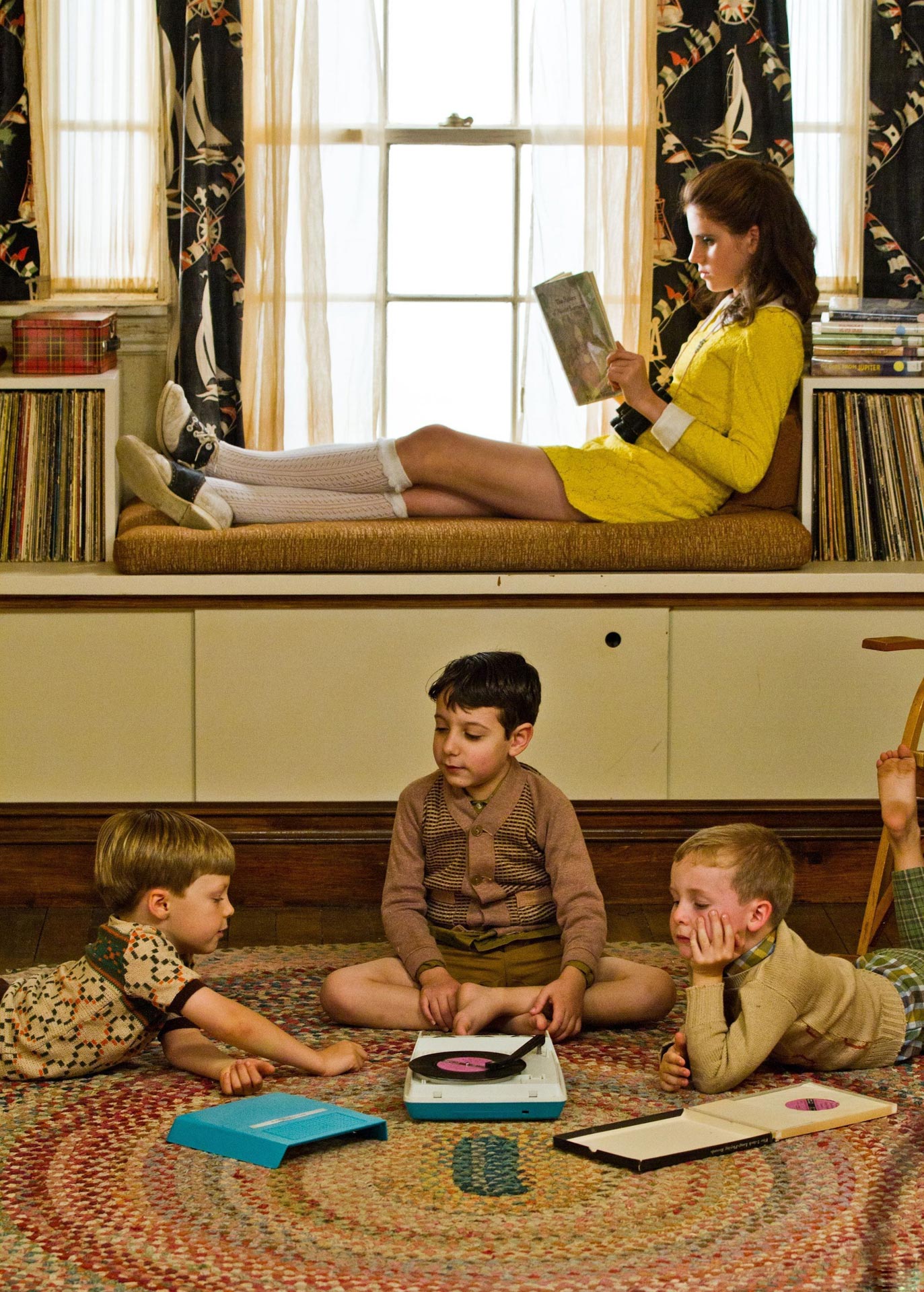
Sam (Jared Gilman) is an orphan with enough issues that his foster parents no longer want him; Suzy (Kara Hayward) is the oldest child of the Bishops and already is labeled as a "very troubled child." They meet at an amateur production of Benjamin Britten's "Noye's Fludde"
**—he's on a scout outing, she plays a raven.
They begin corresponding in secret, and then both escape their cloisters, he from the Khaki Scouts camp, she from her family home.
They live off the land, he with his survival skills and supplies, she with her books and records, a mutually dependent family with different roles. It doesn't take long for their disappearance to be discovered and the search parties form, the police led by Sharp and the Scouts, led by Ward, with the Bishops poking, prodding and threatening lawsuits. The kids lead them all a not-so-merry chase, and there are casualties along the way. But, the fugitives press on, despite the fact that, on an island, they can never really escape.

It's a romantic's version of 'the barefoot bandit" story
, but without the issues of ego, narcissism, and general public nuisance, and Anderson couches it all in an idiosyncratic format with scrupulous Kubrickian stylistic fluorishes—the measured tracking shots, the hand-held shots of freedom and chaos; the stylized expressionless acting, the structured mise en scene, perfectly balanced on a central fulcrum. On top of that, it's hilarious, with dialogue that's formal, distinct, played absolutely straight, betraying no irony, delivered in a deadpan lack of elevation.

It's charming
-no wonder these kids want out, left to their own devices. They still want structure, just their own structure, and, although self-imposed outcasts, seem far more together than those of their "betters."

It's fun
, odd, and rebellious in Anderson's over-stated understated fashion. Wonder what he'll do when he grows up.

* Oh, maybe this was premature. Anderson has since made The Grand Budapest Hotel, The French Dispatch (of the Liberty Kansas Evening Sun), and the wonderful animated Isle of Dogs, each getting increasingly richer, denser, and more sophisticated, all the while maintaining his quirky sense of humor and an almost child-like delight, as if he were playing (as Orson Welles put it) with "the greatest train set a boy ever had."

** Britten is the classical composer-thread rolling throughout Moonrise Kingdom, and his "Young Person's Guide to the Orchestra" is the starting theme for the film's opening sequence—a gliding, tracking tour of the Bishop's house.  They'll also do a version of it over Alexander Desplat's closing music over the credits.

Saturday, February 4, 2023

Women Talking

Only Women Bleed
or
...Then What's a Heaven For?
 
"The Following is a Product of Female Imagination" says the title once the opening narration of Women Talking is finished—opening line: "This all happened before you were born"—and it's a bitterly defiant statement as we've just learned that the women of a Mennonite colony--who are being systematically drugged with cattle tranquilizers, raped, beaten and often impregnated--have been chastised by the men of the colony that their accusations are hysterical, or that they're being visited by ghosts or demons or that it is all a product of "wild female imagination," and holds no truth in reality. Their reality.
 
"Wild female imagination." "Female Imagination" does not bruise and it cannot make pregnant. Men do that in their male imaginations and plots. Because they can. Because they think they can get away with it. Because they can't do it any other way. Because they're allowed to get away with it. Because their authority can't be questioned.
 
And because accusing the men of it (they say, because it's "their colony") will mean that the women won't be able to go to Heaven for their "lies." The men, presumably will, because there's nothing in The Ten Commandments about hypocrisy.
The men have now gone into the neighboring town to try and make bail for the accused attackers. They will be gone for more than a day, and, when they return, the women are expected to apologize...and if they don't recant, they will face excommunication and, of course, not be able to reach the Kingdom of Heaven.
So, while the men are gone, the women take a vote—their first—and because they are prohibited from learning to read or write, It's done with pictographs and X's. 
There are three choices. Stay and Submit. Stay and Fight. Flee. Leave the colony.
The vote is split between "Stay and Fight" and "Leave the colony" and so, the women choose representatives to discuss what will be done, the ramifications, the logistics, what will come next. And to keep a record of their discussion, they recruit the one male left behind, August (Ben Whishaw)—whose family was excommunicated due to his mother's objections to the men's dictates—to record the minutes of their meeting, a record to be left behind.
Three generations of women discuss what comes next: elders Agata (
Judith Ivey), Janz (Frances McDormand), and Greta (Sheila McCarthy), daughters Ona (Rooney Mara), pregnant with the child of her attacker, Mariche (Jessie Buckley) and her children, and Salome (Claire Foy) all gather in a barn-loft to discuss their options and make the decisions before the men-folk come back. They know the situation is intolerable—although Jenz decides that she will stay and leaves the discussions early—and they have to decide what sort of life they want for themselves. And for their children, who are also subject to the men's attacks—the most recent attack was on
Salome's four year old daughter.
It's a particularly appropriate time to have movies like this, as women's autonomy is under attack in this country and throughout the world (it's why the recent adaptation of "The Handmaid's Tale" recently resonated so much in the collective zeitgeist—while the 1990 film of it couldn't make its costs back—and as the #MeToo movement exposed the pervasive inequities in the power structures as women cemented their places in the workplace and in government). The only way to fight the entrenched power structure is in an organized group-dynamic that can up-end the status quo and maybe drown it out.
Women organizing and re-asserting power is as old as "Lysistrata," but writer-director Sarah Polley (Away From Her and Stories We Tell), has other things to discuss in Women Talking besides Fight or Flight. Good Lord, one of these days the Library is going to have a "Revenge" genre in their DVD selections, and that easy solution is dissected and vivisected in the course of the movie, because some of the women just want revenge. This multi-generational congress weighs options based on need, principals, philosophies, and viable futures...which includes going to heaven. In a way, it is it's own version of Twelve Angry Men—call it Eleven Angry Women—where prejudices are revealed, motivations are explained, and minds are changed. And it's performed by some of the best and subtle actors in the field.
If there's a complaint, it's that the introduction is a little rushed, some of the circumstances of the women involved not made clear from the outset, leaving an audience-member confused rather than intrigued. And Polley desaturates her images so far into the gray scale that it could almost be black-and-white. As some directors (Welles and Bogdanovich and Ford) have pointed out, sometimes color can be just too pretty for what you're trying to convey and the film-matter, though set on acres of fields is far from verdant. The film is a tough-sell, anyway, perhaps the distributors insisted on a color film, and this was Polley's solution.
And for anyone who grouses that the film is any sort of "stretch" it's based on a book that took as its inspiration, what was called "The Ghost Rapes of Bolivia," where, beginning in 2005, women in a colony began to be subjected to this type of outrage and decided to leave, trusting in God that She would provide.

Thursday, January 6, 2022

The Tragedy of Macbeth

A Murder of Crows
or
"...Black, Deep Desires"
 
Joel Coen steps away from "The Coen Brothers" partnership to present his own version of Shakespeare's The Tragedy of Macbeth (or "The Scottish Play" if you expect a sandbag to fall from the rafters). There's nothing to fear here: brother Ethan usually writes their stuff and Joel directs with some intersection of duties between the two. But, here, brother Joel already has a collaborator and the material has been proven time and time again (and tomorrow and tomorrow and tomorrow), despite the superstitions that have hovered like crows over every stage production.
 
There have been so many filmed presentations of "Macbeth" and re-imagined scenarios in which it takes place that one wonders what Coen, taking the text, would do with it. He doesn't try to anachronise the story, moving it to Haiti or setting it in Nazi Germany, but keeps it in 16th century Inverness. Presentation of that historical "Macbeth" recalls the way Orson Welles did it in 1948—stage-bound, Academy ratio, black and white, with an eye towards German Expressionism.
It begins with a shot straight up into the sky, the wind blowing, smoke and clouds combining and birds gyrating into the sky. Nature is on alert and moving because man is up to something unnatural—a battle has just been fought. Meanwhile a lone figure (
Kathryn Hunter) scuttles—there is no other word for it—across a dirt path in the fog, muttering to itself and to others. This is Coen's interpretation of Shakespeare's witches, one being, recalling Andy Serkis' Gollum from The Lord of the Rings, but not a CGI creation, but one of theatricality, with twisted limbs like a bird's and a hoarse croak of a voice that feels like nails on a file. The performance is weird without being traditionally spooky and sets you on edge for what is to come.
What is to come is a professional interpretation without too much weirdness. Hunter is a tough act to follow, and she is the highlight in a film that should be full of them. I say that, but it needs to be said with some context. "Macbeth" is a much performed play, both in theater and the cinema (every decade has one film of it, it seems), and, like a symphony—or other piece of music—it can be played in differing manners even if maintaining the ascribed tempo. I might have a "perfect" rendition of the piece (and other listeners another idea of what that might entail) and notice the change of "attack" or emphasis in certain sections. It comes down to interpretation, and "Macbeth" is just as susceptible to those variations.
Like the 1948 Welles version, this one depends on less being more (although Coen cites Carl Theodor Dreyer more than Welles), the backdrops shadowed or cloaked in mist and blocks of perfectly proportioned masonry with less emphasis on grit—as, say, Polanski's version—and the figures walking through them are like mice in a maze. Predestination has created their paths and their choice is to simply follow through or not. It's a curiously unpopulated world, the only crowds being the line of soldiers set to attack Macbeth's castle, hemmed in by the "Birnam wood" of the witches' prophecy, the rest being stark spaces shadowed by the blackest blacks.
Through these spaces, the characters pace, for the most part sheltered from the wild outside that knows no geometry of straight lines, but intrudes—once the Macbeths screw their courage to the sticking place by regicide—not only by physical presences, but by the sound of that nature booming (not just knocking) to be let in, like consciences made tactile.
The acting is great throughout, with Brendan Gleeson, Alex Hassell, Stephen Root (!!), Moses Ingram, and Frances McDormand all breathing new life into the texts, bridging that Elizabethan gap of Shakespearean prose by the sheer force of performance. Denzel Washington does well (as well), bringing a maturity to the role rather than—as in some versions—as a walking personification of overweening ambition. It is only in his interpretation of the "Out, brief candle" speech that leaves a little something to be desired at that critical junction of the play. 
Up until then, Washington's Macbeth is a pragmatist, slightly world-weary and seems beaten down—he has just come from a war, after all. What is most interesting is that both Macbeths in this iteration are older, childless (so no chances of succession), and obviously have seen chances for advancement taken away from them in the past, and that, now, with this hope given thought by a supernatural origin, are almost desperate to take advantage of it, lest it pass from them one last time. Once he is king, and things start to fall apart, one would think there would be more shock, more realization that he might have been duped by the very forces that emboldened him. But, that's not there. Instead, it seems he's returned to the world-weariness at the beginning of the film—which is inconvenient as he still has much to fight. It feels false, and is missing a sense of bitter desperation that will carry him through the inevitable end.
Still, it's a beautiful, often mystical film to watch and listen to. And it's always a welcome break to just take in Shakespeare to relieve oneself of the mundane nature of everyday-speak, and glory in the poetry and precision of his story-telling.


Friday, November 5, 2021

The French Dispatch

"Just Try To Make It Sound Like You Wrote It That Way on Purpose"
or
The Good and the Adject-Evil (Not Necessarily in a Bad Way)
 
Wes Anderson's new little chocolate toy-box of a movie is The French Dispatch (of the Liberty Kansas Evening Sun)—written with Roman Coppola, Jason Schwartzman, and Hugo Guinness—centered around the arty-little adjunct magazine that resulted when the son of the editor of Liberty Kansas Evening Sun, Arthur Howitzer, Jr. (played by Bill Murray) spent an extended holiday in the French village of Ennui-sur-Blasé and never returned home, instead creating an supplement for Dad's paper—"a factual report on the subject of world politics, the arts, high and low, and diverse stories of human interest."
 
Already, the town's name had me giggling, as not only is it a hilarious name for a burg (especially in France), but it also is the perfect site (and attitude) from which writers could concoct articles in a "New Yorker frame of mind". The movie centers around that magazine on its final issue of publication, pursuant to the wishes of the editor upon his death, that it cease and all of its assets liquidated. Thus, it consists of "an obituary, a travel guide, and three short articles" that have been culled from the magazine's past.
The obituary is, of course, Howitzer's, and it is inextricably tied to the magazine's history with no future—and reassuring subscribers that they will be refunded for the remaining issues that will not be forthcoming.
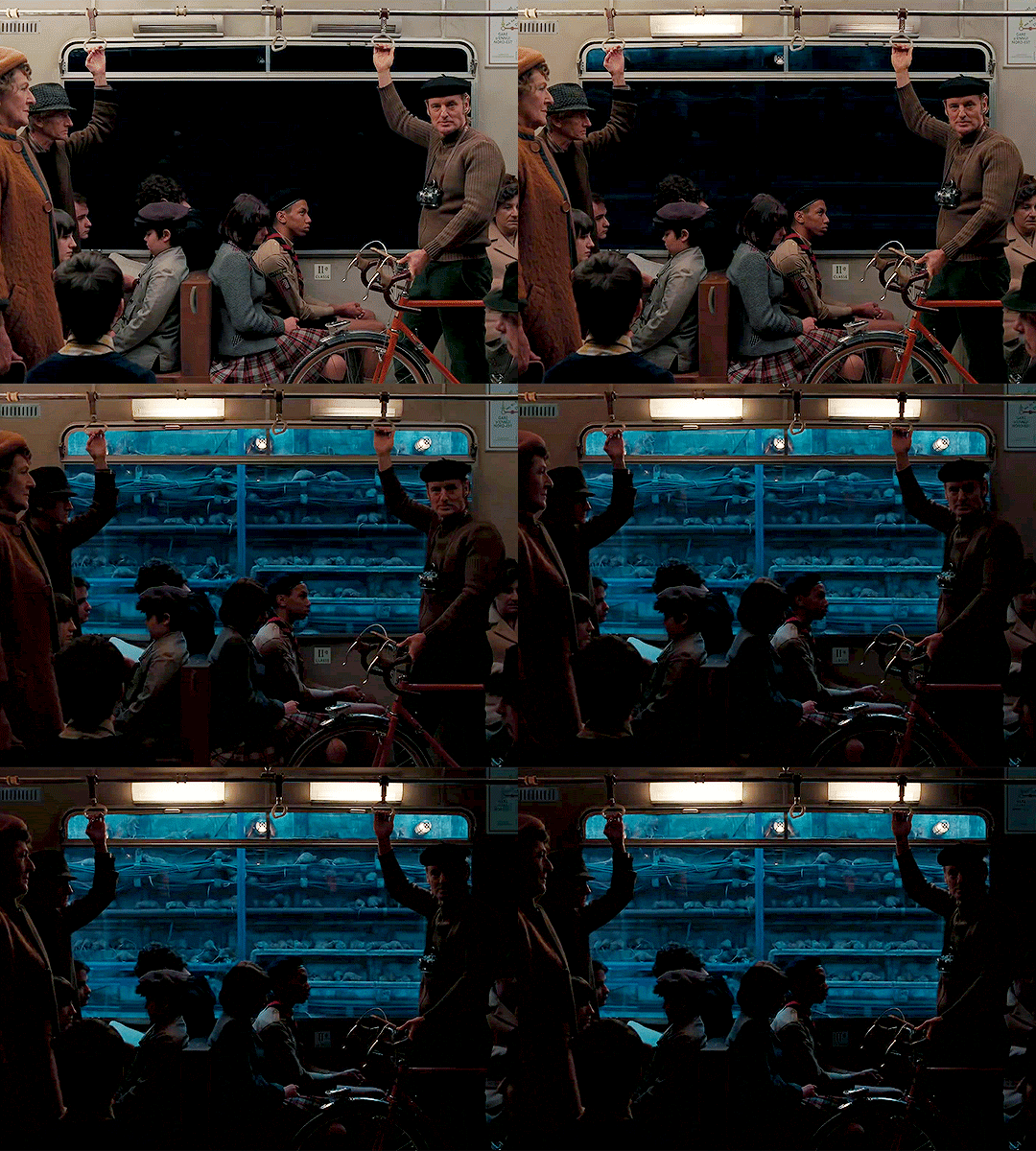
Next is a tour of Ennui-sur-Blasé with bicycling reporter Herbsaint Sazerac (Owen Wilson) who pedals about the village (often precariously) giving a guided overview of its piquant and sordid charms—for example, that it hides a vast population of vermin and scavengers (as illustrated above) and the curious statistic that 8.2 bodies are pulled from the local river every week.
The first of the stories—"The Concrete Masterpiece" tells the story of an art dealer (Adrien Brody), imprisoned for tax evasion, stumbling upon a masterwork by one of the mentally disturbed inmates, Moses Rosenthaler (Benicio Del Toro), inspired by his muse and lover (and guard) Simone (Léa Seydoux). He buys the piece and Rosenthaler becomes a sensation in the art world, but his methods are idiosyncratic to say the least and his latest work, three years in the making, proves problematic to its patron. The story is presented as a lecture by art historian J.K.L. Berenson (Tilda Swinton) and features appearances by Tony Revolori (from The Grand Budapest Hotel), Bob Balaban, Henry Winkler, and Lois Smith.
The second story is "Revisions to a Manifesto" in which a reporter/Witness to History, Lucinda Krementz (Frances McDormand) struggles with objectivity in her reporting of a youth revolt (called "The Chessboard Revolution") in Ennui, led by the charismatic Zeffirelli B. (Timothée Chalamet), who struggles with writing his manifesto—writing it in the cafe doesn't work, nor does writing it in his bathtub—and comes to rely on Lucinda to finish it.
The final story—"The Private Dining Room of the Police Commissioner"—is structured around a television interview (hosted by Liev Schreiber) with the article's author Roebuck Wright (Jeffrey Wright, no relation) who recounts the circumstances of a dining review of the exquisite meals prepared by the police lieutenant chef Nescaffier (Stephen Park) for Ennui's police commissaire (Mathieu Almaric) only to be embroiled in an investigation when the chief's son is kidnapped (by a gang that includes Edward Norton and Saoirse Ronan). It offers a chase sequence done in animation.
Still with me, there?
 
This may be the densest, most convoluted, detailed and realised of Wes Anderson's little confections, linked by his distinctive, reductive style of boxed-in, symmetrical (well, for the most part) compositions, and an acting style that would best be described as "Keaton-esque." The film zips along like a cartoon, heavily narrated and presented with layers of cascading framing devices and in a mish-mash of black-and-white and color in different aspect ratio's that have no narrative function other than to clash with the scene before it. Plus, reality is constantly challenged with animation (mentioned before), deliberate model-shots, and an extremely porous fourth-wall. The phrase I keep seeing in reviews is it's "the most Wes Anderson movie of his movies."
Of course it is. Even as he's stealing tricks and homages from shot-to-shot (but not for very long). It IS "The Most Wes Anderson Movie Of His Movies."
 
But not necessarily in a bad way.
You don't get lost, even when the director takes you down so many rabbit-holes your eyes might pop out of your head and your brain starts to take on a misty quality. Nor is one ever bored—unless one is so churlish as to ask "What's the point?" The film clocks in at an hour, forty-eight minutes and is so crammed with...."stuff"...that boredom seems impossible. Synaptic hemorrhaging, maybe, and a lot of such "stuff" is going to go right over your head, but it's so filled with detail—such as writerly nuance—that one can just absorb the layer of adjectival meticulousness until the next funny-bone prod comes along.
Call it a soufflé, if you will, filled with different textures and flavors, that might not be recognized as one is gorging on it, but might pop up with recognition when contemplated as a grand meal.